
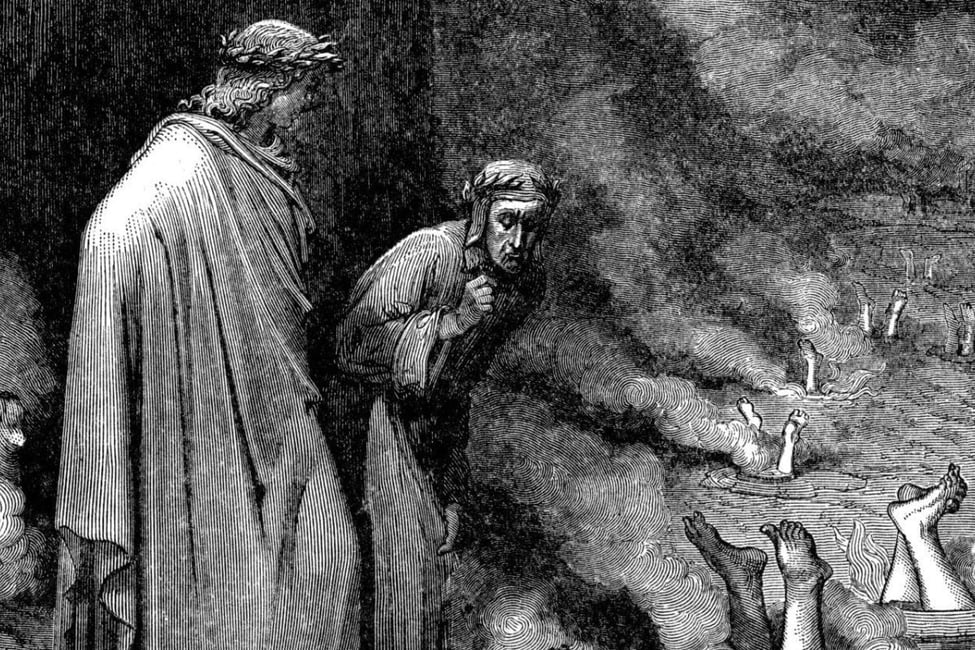
Picture Credit to: https://divinity.uchicago.edu/sightings/articles/road-hell-dantes-inferno-and-undermining-trust
There’s a shift happening, a deep undercurrent that no one seems to want to name.
It’s not just about interest rates or tariffs or the Bank of Canada hesitating like a king who suddenly doubts his own authority. It’s bigger than that. It’s the creeping realization that power isn’t where we thought it was. That maybe it never was. That control—our control—is an illusion, and whatever democratic safeguards we believed in have either eroded or were never really there in the first place.
Fear governs now. But not the kind that sends people running—it’s the kind that settles into a nation’s bones. The kind that makes you stop asking questions because you already know no one is listening.
Meanwhile, the U.S. is undergoing something entirely different.
It’s frenetic and startling, yes, but it’s also a return to self-determination, a nation leaning hard into its original DNA—a republic built on the individual, not the collective. It is not polite, it is not orderly, but it is happening. Canada, by contrast, feels stuck. Not a democracy in action, but one that exists on paper—a managed entity, not a self-determined one. Parliament is prorogued. The people have no say. Government continues, but governance does not. Is this a transition? A controlled descent? And if it is, who is at the wheel? We like to believe we are governed by elected officials, but if elections can be delayed, denied, or rendered meaningless, then what remains? If Parliament is frozen, but decisions are still being made, then who is making them? I don’t know if this is what people mean when they talk about a shadow government, or if this is just a system resisting its own collapse but I do know this: when leadership becomes untouchable, when power becomes inaccessible, and when fear replaces choice, democracy is no longer real.
These are my observations, not my convictions. I don’t know if this is real, or if this is just what it looks like when an old system starts to break down. Maybe this isn’t a landscape anymore at all, maybe it’s a hellscape in disguise - and the closer you look the disguise is not very convincing.
And does it matter? I ask myself this daily.
How much does any of this actually affect real estate? Should it? On paper, it shouldn’t but here’s the thing: when people stop believing in the future, they hesitate to invest in it. Markets are built on confidence, and confidence is built on stability. But what happens when stability isn’t real? What happens when hesitation becomes the dominant economic force, when people aren’t sure what the world they’re investing in today will look like tomorrow?
I don’t know what happens next but I do know how I feel and I know I’m not supposed to feel this powerless.
There’s a peculiar thing that happens when people lose faith in change, they defend the system that keeps them trapped. Not because they love it—but because they no longer believe in anything else.
In psychology, we call this Stockholm Syndrome—when captives begin to identify with their captors, justifying their own oppression as a survival mechanism. It’s what happens when the mind bends to the shape of its cage. Oppression becomes protection. Compliance feels safe. Will we even notice when oppression becomes subjugation? Parliament is frozen. Power remains concentrated in the hands of the untouchable few and yet, many defend it. They say stability requires submission, that change is dangerous, that the system still serves us even as it bleeds us dry but submission is not stability and a democracy where people stop believing their voices matter is no democracy at all.
Here’s the real question: Are we defending the system, or are we just afraid to admit we have no control over it?
Stockholm Syndrome isn’t about love—it’s about survival. It’s what happens when resistance feels futile because surviving an environment replaced thriving in an environment and isn’t that exactly what we’re being conditioned to accept? Will be become a society riddled with PTSD after being willingly incubated in the petri dish we call Canada?
We are watching the slow erosion of democratic participation. The centralization of power. The normalization of uncertainty and yet, most people aren’t panicking we're shrugging, rationalizing, defending the very thing that has made us powerless and maybe that’s the most dangerous thing of all.
As we stand here—unsure, hesitant, waiting—even the Bank of Canada has no answers. A Posthaste article recently highlighted how the Bank of Canada, once looked to as the steward of economic stability, might just be as uncertain as the rest of us. Tariffs, inflation, global instability—whatever control they once had is slipping. The ones in charge don’t seem to know what to do - and the ones who put them there (us) aren’t being given a choice.
So we wait.
We wait as real estate prices fluctuate. We wait as interest rates wobble. We wait as power accumulates where it was never meant to stay and in the meantime, we tell ourselves it’s fine. That this is just how things are now. That this is normal.
But it isn’t. It never was and the real danger isn’t that power has been taken from us overnight—it’s that we’ve become so accustomed to not having any that we stop noticing. The question isn’t whether we’re being governed the question is whether we’re just hostages who’ve forgotten the door was ever open.
If you have time for a thought provoking read Herman and Chomsky wrote a book called Manufacturing Consent: The Political Economy of the Mass Media
https://financialpost.com/news/bank-of-canada-struggles-tariffs-neutral-interest-rate